Time of Gratitude by Gennady Aygi
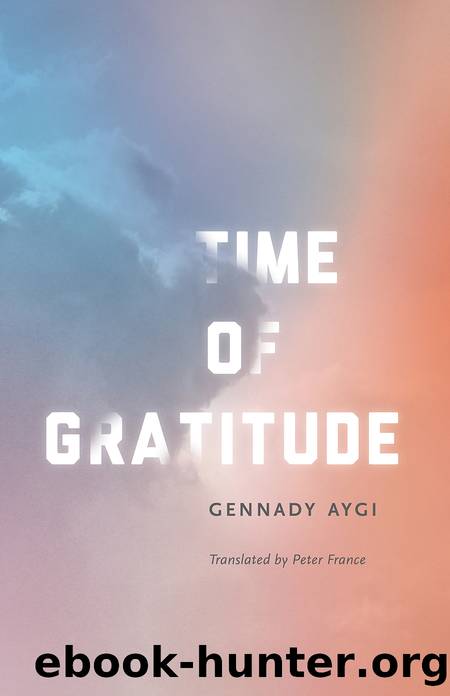
Author:Gennady Aygi
Language: eng
Format: epub
ISBN: 9780811227209
Publisher: New Directions
Published: 2017-12-12T00:00:00+00:00
Yes, Kruchonykh Himself, or The Least Known of the Most Famous
In the history of Russian poetry there has possibly been no greater injustice than that which has been done, and is still being done, to Aleksey Kruchonykh.
Our literary scholarship has never attempted to seek out what is essential in his work. Kruchonykh was needed as a âscapegoatâ: for half a century the âsins of the Futurists,â Vladimir Mayakovsky and Velimir Khlebnikov, have been deflected onto him.
Krucha, Krykh, Kruchik, Kruchen, Kruch. âForgot to hang myself, flying to America!â Zudesnik, zudar, zudivets, and his poems in Zudutnye zudesa. âMasters of precision, having sealed our ears with wax so as not to hear the sirensâ serenades, we shout like alarm clocks that delicate hearing cannot endure: rrrrrjjjtzzzziiiii!...â
Mayakovsky deafened his hearers; Kruchonykh woke them up, got on their nerves, âdrove [everyone] madâ (but in life, among friends, he was the most peacable of men).
His sharpness, his irrepressibility, his deliberately planned stunts, the way he popped up everywhere, his unfailing witticisms â all this allowed him to be seen as a âwonderful eccentricâ (as Mikhail Svetlov put it). This was indeed the âpositive reactionâ to Kruchonykh of many of his friends and acquaintances (âKruchâ was strikingly sociable) â itâs a way of rendering poets harmless, as Velimir Khlebnikov has been treated up to the present day.
âFor thirty years Iâve been trying to clean out peopleâs brains in relation to Kruchonykh,â Nikolay Khardzhiev said to me when we first met in 1961. Maybe he managed to clean out half a dozen.
It was easy to be condescending to a poet who was rejected by society. I saw him drawing his pension; if I remember rightly, it was thirty-one roubles. Kruchonykh hadnât been published since 1930 (symbolically, this dividing line was the year of Mayakovskyâs death). I have never met a more joyful poet. In all circumstances, he was artistic and aristocratic. These qualities harmonized miraculously with his Russian peasant appearance â the lines of his face suggested a kind of rustic enlightenment and even, for all his anticlericalism, something distantly Orthodox.
âI have three whales supporting me,â he used to repeat with pride in the last years of his life, âthey wonât let me fall.â
He meant Malevich, Khlebnikov, and Mayakovsky.
Yes, he was Malevichâs favorite poet. âOnly Kruchonykh has remained in me like a rock, unswerving in his love for the New God, and he remains so still,â the great Suprematist wrote in a 1916 letter to M. Matyushin. And Mayakovsky subsequently trumpeted this slogan-like phrase about Kruchonykh: âA genuine poet, a cultivator of the word!â
Out of habit (as Kruchonykh himself did), we are still citing authorities for our literary rehabilitation of the poet of trans-sense (zaum). But Kruchonykh has no need of this on the world stage. For the last twenty years there has been a âKruchonykh boomâ in European literary scholarship, with endless articles about the poet and some fundamental academic research.
A remarkable literary theorist and linguistician, he was responsible, with Khlebnikov, for stirring up the linguistic thinking of his time.
Download
This site does not store any files on its server. We only index and link to content provided by other sites. Please contact the content providers to delete copyright contents if any and email us, we'll remove relevant links or contents immediately.
The Universe of Us by Lang Leav(15124)
The Sun and Her Flowers by Rupi Kaur(14566)
Adultolescence by Gabbie Hanna(8962)
Whiskey Words & a Shovel II by r.h. Sin(8050)
Love Her Wild by Atticus(7788)
Smoke & Mirrors by Michael Faudet(6231)
Wiseguy by Nicholas Pileggi(5841)
The Princess Saves Herself in This One by Amanda Lovelace(5003)
Love & Misadventure by Lang Leav(4883)
Memories by Lang Leav(4843)
Milk and Honey by Rupi Kaur(4774)
Bluets by Maggie Nelson(4604)
Too Much and Not the Mood by Durga Chew-Bose(4386)
Pillow Thoughts by Courtney Peppernell(4326)
Good morning to Goodnight by Eleni Kaur(4261)
The Poetry of Pablo Neruda by Pablo Neruda(4167)
Algedonic by r.h. Sin(4089)
HER II by Pierre Alex Jeanty(3639)
Stuff I've Been Feeling Lately by Alicia Cook(3489)
